After a high level of extinctions at the end of the Cambrian, 490Mya, life rebounded, especially plankton, and their feeders the brachiopods and graptolites, as well as the trilobites.
Graptolites were floating planktonic pterobranch hemichordates.
'Articulated' Brachiopods
The trilobites diversified, from planktonic to 1m heavyweights.
Aegirocassis a 2m filter-feeding giant arthropod
Sea Scorpions evolved from chelicerates; they had claws, but sucked their prey, probably coming on land to moult and mate, the largest up to 3m.
One line of mollusks diversified; their 'radula' tongue can bore through anything even shells or crustaceans.
Gastropods can retreat into elaborate protective shells
Limpet
Cowrie
Sea snail
Bivalves lost their head, and foot, and shut themselves in a double-shell, filtering food from a tube.
Clam
Cockle
Scallop
Cephalopods used the shell as a float, freeing the foot to form hunting tentacles and a strong beak; as carnivores they developed large eyes and intelligent brain, and a heart circulation; replaced the Anomalocarids as top predators, including a 10m species.
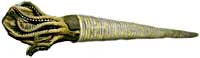
Tusk shells
Nautiloids
The age of filter-feeding reached its peak and started its decline. Echinoderms radiated out, many becoming benthic feeders.
Sea stars "upside down" active predators of mollusks and worms
Sea urchinsherbivores of algae
Sea Cucumbers detritivores
Vertebrate Fish — Conodonts
One line of 'hagfish' developed stronger cartilage:
a cartilage backbone, a bony scale exterior;
a closed blood circulation with heart, liver, hormones etc.; lymphocytes with antibodies;
used their mouth to suck in prey, crushed with some teeth, and digested in a stomach;
the gills were now used only for respiration.
Although not as abundant as the other fish, they filled in a stable part of the food-web. Two major groups evolved:
Ostracoderms
One group had an 'armored' plate on their head, made of bone (Ca5(PO4)3OH in collagen). They hid in the sand in ambush to suck in their prey with a sudden opening of the mouth. Most were 2-5cm.
Thelodonts developed lateral fins to swim fast, supported by their light scaly body.
Meanwhile things were getting interesting on land. Cyanobacteria and algae, together with their consumers, the ciliates (in warm climates) and the forams and shelled amoebae (in cold), had long lived successfully in wet soil, adding to its organic content. Some amoebas overcame the problem of meeting for fertilization without using water — they send a signal to amass as a slime mold.
The chytrids also adapted to living in wet soils, becoming the first fungi, as molds decomposing decaying organics.
But it is the lichen fungi (symbiotic with green algae or cyanobacteria) that became well-adapted to living in the comparatively dry and searing hot/cold conditions of the atmosphere.
At about the same time, 475Mya, multicellular fresh-water green algae began to form the first plants, living on moist shaded shores of tropical streams. These small liverworts have one-cell-thick 'leaves', covered by a cuticle to avoid drying, but with stomata on their stems to absorb CO2. Why did they take so long to colonise the land? It could have been the high UV radiation, that at this time was reduced by the formation of ozone (from oxygen).
are haploid multicellular algae living in lakes; they produce male gametes on stalks, which swim to reach another stonewort's egg-gamete on its stalk, fuse, perform meiosis to yield several motile haploid spores.
have stomata in their 'leaves'. Their male gametes still need rain-water to swim, but the spores are wind-blown.
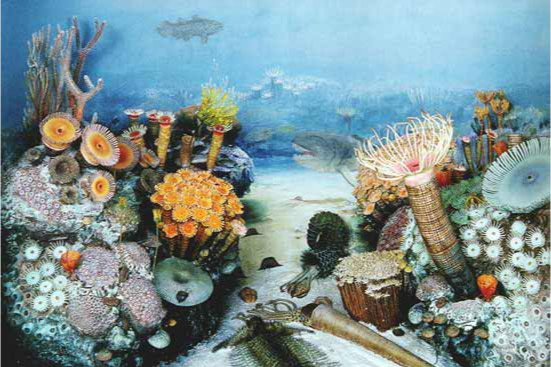
Feeding on the plankton were the brachiopods and graptolites, reefs of sponges, bryozoans and corals, as well as the sea-lilies, while the trilobites, sea-snails, and various worms, ate the bottom algae/organics and sea-weed. The whelks and the nautiloids, plus some sea stars and ostracoderms, made up most of the predators, while the fish scavenged for any remains.
450-400Mya: Silurian
At about 450-445Mya, a great ice shield formed over the continent Gondwana, which was at the South Pole, lowering the sea level, and draining the continental shelves. A major extinction of species ensued.
Following the ice age, the plankton, along with the brachiopods and graptolites recovered, but there were now more tropical Coral (anemone) and Sponge reefs, with increasing numbers of Mollusks and Ostracoderms, replacing more trilobites. On land, the lichen, fungi and liverwort continued to increase, forming the first soils with organic material.
Peridinium
50µm
Ceratium
The eukaryotic dinoflagellates developed exterior plates, with a poisonous 'harpoon'; it whirls around; half are symbiont with a chromist, became the dominant phytoplankton (eaten by radiolarians).
The chromists also diversified — the multicellular brown algae formed kelps, rockweed and seaweed.
The nautiloids diversified, some had coiled shells with a gas-filled rear to move up/down the depths, and as defence against bites.
Ammonites
The sea scorpion group became widespread as second-top predators, with claws, some had a stinging tail.
Pterygotus, 3m
Fish
Although the ostracoderm fish became widespread, it was the finned thelodonts that diversified most: in the sea, and fresh water, possibly following a whole genome duplication. They had a more complex brain with myelinated axons, allowing for 100× faster transmission of neural signals and hence quicker reactions.
ThelodontsVarious groups had bone plates.Anaspids
Some thelodonts evolved jaws and opercula that open and close to force water through their gills; one hunter group evolved sharp teeth on their jaws, that regenerate, movable eyes with color vision, well-developed fins and a lateral line.
Shark-like fish
Bony Fish developed a buoyant swim bladder (from the stomach), allowing for stronger (and heavier) bone vertebrae; became widespread.
Placoderms with an armored head and a powerful bite.
On land, the fungi dominated as the major decomposers, along with bacteria. They form a mycelium of hyphae, consisting of fused cells with a chitin cell wall, around the decomposing matter to absorb nutrients; then they form wind-blown spores on top of a stalk. The larger ones can be acres large, and form mushrooms to launch the spores, the largest (Prototaxites) reaching heights of 8m. Some formed symbiotic relations with plants, giving back nitrates and phosphates.
LiverwortsThe first vascular plantsMoss
Liverworts (and 'hornworts') became widespread in shaded wet regions of the tropics and diversified. One type, the mosses developed 'roots'-'stem'-'leaves'. The latter are still one cell thick.
Among the mosses, one species had rhizomes with spore-producing stems, mostly without 'leaves'. It could live on drier soil, even in direct sunlight, by having vessels (xylem) to transport water from its roots. Its upright stems could grow up to 50cm high. It was the first vascular plant.
Following the plants and fungi, several fresh-water crustaceans adapted to land, evolving tracheae for respiration.
One group became the herbivore Millipedes and the carnivore Centipedes.
Another group of small detritivore fresh-water shrimps adapted to land, eating lichen,..., and became the springing spring-tails, bristle-tails, then silverfish.
Earthworms A fresh-water bristleworm species adapted to moist soil, eating dead leaves.
400-350Mya: Devonian
In the seas, the coral reefs with articulate brachiopods dominated the life forms, with smaller numbers of trilobites, sea-lilies, graptolites, gastropods, and ammonites and vertebrate fish.
Fish
The diversifying jawed toothed fishes increasingly ousted the ostracoderm and thelodont fish (and the nautiloid predators), by 380Mya.
Placoderms
became widespread, with large benthic or swimming top predators.
Dunkleostus, up to 9m longSharks
Lobe-finned fish developed 'shoulders' and limb-like fins; became widespread.
Coelecanths
Ray-finned Fish faster and maneuverable, lost their heavy scales; thin fins supported by rays; do not need to gulp air; but remained small and rare.
Freshwater lung-fish can hibernate out of water (e.g., to survive dry season), with modified swim-bladder as lungs to get oxygen from the air, pancreas & spleen, and converting NH3 to urea.
390Mya Some adapted to shallow fresh-waters; they maneuvered with feet (5–8 digits), a neck, and a muscular tongue; they could breathe air through nostrils and had a partly divided heart, but could hardly hear or see clearly out of water.
Shrimp
continued to diversify.
Krill plankton-feeders, form a large part of the animal biomass.
Mantis shrimp predators with stabbing front legs and excellent vision.
Isopods (wood louse) live on seashore or inland.
Mussels evolved from bivalves, as inter-tidal burrowing filter-feeders.
Sea Spiders chelicerates that suck on sea anemones.
Meanwhile, the vascular plants became widespread along streams. They 'colonized' the land, at least the moist parts, with species adapted to different levels of humidity.
Some vascular mosses had one main stem and several branches.
Club Mosses
One group, the lycophytes, developed a quick-growing stem, some with branches at regular periods, and small 'leaves'; small haploid extensions formed at the ends to produce spores. They lived in damp or swampy soils.
Ferns
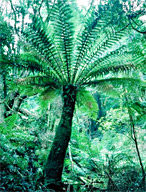
Another group developed repeated branching to the tips; when filled in by cells they were the first true leaves. They are supplied by xylem (wood) for water transport and phloem for general transport, going from roots to stem and branches. They are adapted to less moist soil.
Land became more and more productive and green, and the first forests appeared about 390Mya, with club-moss trees and fern-trees competing for light, growing straight vertical trunks full of lignin (wood); nematodes, insects and millipedes were able to flourish in the undergrowth.
Club mosses
lived in swamps.
Lepidodendron, 35m tallFern trees in humid soil
The most hardy fern-trees had deeper roots, a thickening stem with bark ("secondary growth"), and buds for seasonal growth.
Archaeopterisstem cross-section
Some fern-trees evolved pollen that is wind-blown to a female plant's collecting organ, the cone, where it 'swims' to fertilize the egg, and forms a large seed; these trees were now independent of moist soil.
A significant development occurred around 320Mya. An aquatic silverfish evolved wings from its gills. After spending most of its life in a pond, it climbs a plant, molts and dries its wings to disperse to other waters and mate.
By the end of the Devonian 375-355Mya, volcanism in Siberia, or a series of ice ages which lowered and raised the seas, caused a number of low oxygen extinction events of the reefs, together with their remaining trilobites, many brachiopods, and most of the fish: ostracoderms, thelodonts, placoderms, and lobe-finned fish.
350-300Mya: Carboniferous
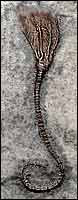
Fish continued to dominate the seas, along with brachiopods, coral reefs, bryozoans, crinoids and blastoids, ostracods, and plankton, plus bivalves and ammonites. Sharks and 4m coelecanths replaced placoderms as top predators of fish, brachiopods and shrimp.
The gastropods, now smaller, spread out as the main herbivores: they have an elaborate biochemistry; some converted their gills to lungs, and became land herbivores.
Whelks large huntersSea SnailsSnailsSea Slugs (highly poisonous, don't need the shell)
The lycophyte swamp-forests proliferated in the warm tropical climate. Among the large scale trees, there was a dense fern undergrowth.
Ferns diversifiedHorsetail were specialized ferns, largest 20m.
As photosynthesis went global, oxygen levels increased up to 30%, reducing CO2, and possibly worsening an ice age; the fluctuating sea levels caused vast inland swamps to be drowned in sea; the rotting trees were repeatedly buried in sediment as peat, becoming carbonized coal with time. Insects grew in size up to 50cm wingspan.
In this new forest environment, all the first land animals diversified:
became predators of the insects waiting in ambush in ground holes, some with a sticky silk trip-line to detect them, and biting them with their paralyzing venom.
Even more successful however were the Mites (tiny detritivores) and ticks (parasites of animals).Arthropleurida a 2m millipede
Meanwhile, a group of tetrapods had adapted to living in the swampy lakes under the forests, shared with the scorpions. These amphibians, growing from tadpoles in the water, became increasingly adapted to the land, with a firmer pelvis and shoulder; better eyesight and vibration-hearing; urea to retain water; double circulation to lungs/body. By the end of the period, they had become ubiquitous in these habitats.
Ichtyostega
had shoulders, ribs, stronger limbs to walk on land.
Temnospondyls Eryops
had a croc-like life-style, eating arthropods and fish.
snake-like amphibiansReptiliomorphs
One group was more terrestrial; the adult form did not lose as much water — it had proper lungs, a tougher impermeable skin, and more powerful kidneys.
300-250Mya: Permian
Starting 306Mya, the climate changed towards drier and colder conditions, as carbon dioxide is reduced and the supercontinent Pangea started to form. This led to a "rainforest collapse".
By 270Mya, the horsetails replaced the lycophytes in the forests, because of increasing drought, while the gymnosperms increased in numbers. The giant millipedes and dragonflies died out.
The seas' ecology remained roughly the same: plankton, with reefs of sponges and corals, bryozoans and brachiopods, crinoids and gastropods, ammonites, ray-finned fish and sharks.
The new niches on land were taken advantage of by the winged insects: By 250Mya they had filled in most of them by their varied forms. The most successful insects led a double life: one as a growing larva, which then hibernates as a pupa, and makes a dramatic metamorphosis to the adult flying form.
larvapupaadultBeetles protect their wings in a sheathSawfly can stingScorpion flyCaddis fly have a needle-like sucking mouth.
Pines and firs, Araucaria, later Cypress, Sequioa redwoods, Yew
female cone to capture pollenGingko with berry seedsGlossopteris female cone
Rot fungi acquired the ability to efficiently break down lignin in rotting wood, diminishing the formation of peat (hence coal).
A group of reptiliomorphs evolved the egg: following intercourse, and internal fertilization, the embryo is covered with a watery yolk and a semi-permeable 'skin' that permits air in but limits evaporation, allowing the young to live its 'tadpole' stage inside the egg. (The disadvantage is that tens not hundreds of these 'expensive' eggs can be laid at a time.)
These are now the reptiles, independent of the water. They are active during the day, with sight as the main sense. The reptiliomorphs and amphibians continued successfully in their niches, restricted to ponds, but it was the reptiles that flourished in the gymnosperm forests. They proliferated, giving rise to three main branches:
carnivores, with powerful jaw muscles and legs, are the most successful.
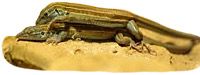
AnapsidsCaptorhinus small insectivores in Africa.Diapsidslived near sea-shoreEdaphosaurus herbivoreDimetrodon top predator
Pelycosaurs
Filling in new herbivore and carnivore niches, the synapsids became large, some with a sail to warm up in the morning.
Caseids huge 4-6m herbivores
As the climated changed, the pelycosaurs died out, replaced by a new breed of synapsids. These are the Therapsids, mostly carnivores adapted to the drier and cooler climate and latitude of Asia — they could run, probably had a divided heart, 'warm'-blooded (e.g. 30°C) (as their legs lift them and insulate them off the ground), so needed 20 times more food.
Dinocephalians 3-6m giants, including head-butting herbivores, and carnivores.Dicynodonts burrowing herbivores, possibly with hair.
Then the dinocephalians died out in the hot climate, replaced by a new set of faster therapsids, now able to make sustained runs — they have a diaphragm for rapid breathing, and red-blood cells. Some have specialized teeth that do not regrow: incisors/canines/molar.
GorgonopsidsCynodontsDicynodonts Diictodon
Meanwhile the amphibians, and the anapsid and diapsid reptiles still existed:
ScutosaurusProtorosaurusClaudiosaurusPaliguanaDiscosauriscus an amphibian
Anapsids
Diapsids
The Great Dying
250Mya an extremely severe mass extinction took place (due to Siberian volcanism producing acid rain or greenhouse gases for 1My, combined with methane release in oceans?) — most (95%) forams, corals, crinoids and blastoids, echinoids, brachiopods, all trilobites, ammonites, sea scorpions, lancelets, sharks, therapsids, anapsids, etc., were no more.
Life was slow to recover, because of the loss of oxygen: it survived in the polar regions, but it took more than 0.5My for species to refill the niches, and nearly 20My for forests to regrow to their former size. The forests that regrew were now mostly of cycads and conifers (although horsetail and glossopterids still fluorished in the south).
The new marine species were more mobile and less filter-feeding. Bivalves (and starfish), which replaced the brachiopods, and gastropods, echinoids and ammonites were the first to recover. Coral reefs were back to small patches of new types. Bony fish were more common.
The climate was, if anything, getting hotter and drier than before.
Horseshoe 'crabs' are the only remaining species from the trilobite-like families.















 adult
adult