
An Automatic Plant Watering Device.
Introduction: My technology project consists of an automatic self-watering device that waters the plants when the soil moisture sensor, attached to the device, measures a low soil moisture and overrides manual irrigation to keep soil moisture level adequate. It is like hiring someone to water your plants.
Thanks to such a device the plants can look after themselves because this sort of device ensures a constant supply of water for the plants. So there is no risk of over watering the plants. It is like a plant sitter for the reason that it avoids fuss, mess, spills and watering cans. One can enjoy his or her houseplants every day without worrying about maintaining a watering schedule.
This device is mostly appropriate for those people who travel a lot and go on vacation or business trips and value their house plants. Also such a system eliminates the need to water frequently when you are at home. It is simple and easy to install and use for all types of containers and can be used for plants of various sizes and varieties. Apart from being useful for potted plants, similar devices are also practical for fields of vegetation in areas where the soil lacks water or where there is a serious drought. The device works with your plants as they are and so there is no need to repot. It is also convenient because it provides an easy way to water those hard to reach plants. Since fertilizer can be added to the water supply, this apparatus can also feed the plants over time and so can be used to automatically fertilize while watering and encourages fruitful growth.
Research on matters connected with the project: The electronic circuit used for the project as adapted for the special case of an automatic plant waterer is shown below.
Description of circuit: When the sensor is wet it has a lower resistance which allows a current I (a few milliamps) through the base to the emitter of the first transistor Tr1. This current is amplified by this transistor by a factor β so that a current βI passes through the base to emitter of transistor Tr2. This last transistor further amplifies the current let us say by β again so that the collector current of this transistor is approximately ββI which is several milliamps and enough to operate the relay RLY. The relay has two sets of contacts. One set can operate a solenoid valve under dry sensor conditions. The other operates an indicator lamp. In the model a solenoid valve was not used since it was not immediately available for 6Volts. Instead a 6Volt small motor was used which represents a motor driven pump which of course is a possible alternative.
Building of the circuit: The circuit was built on veroboard after the necessary components were bought. The components were as specified in the original circuit diagram or for some components as dictated by need after the necessary research. A list of electronic components follows:
Vero board
Tr1, transistor BC108
Tr2, transistor BFY51
R1, resistor 1KΩ
Bulb, 6V and holder
RLY, relay with 6V coil and 2 pole changeover contacts
Motor 6V d.c.
Battery holder with connector
Rectifier diode
Electrolytic capacitor 100 μF
The sensor: At first the sensor consisted of a piece of veroboard to be fitted just under the soil. At the testing stage a probe was tried consisting of two needles in a china block connector. This proved very effective and was used in the final version.
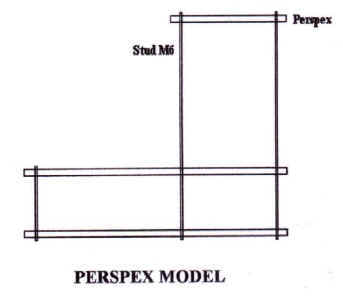
Mechanical construction: Three pieces of perspex were cut to form the three layers of the model. Holes were drilled for mounting studs of size M6. The edges of the perspex were filed to the correct finish.
The top layer was drilled to accommodate the 8mm elbow. The tank consisting of an empty preserve tin, roughened and painted black, would be fitted here.
The second layer will have a hole for the pot and accommodate the circuit board. The large hole was cut with a hole cutter.
Finally the pipes and sprinkler were connected to the tank by means of the elbow. The sprinkler consists of a piece of rubber with a piece of stainless steel sheet drilled with several small holes. Silicone compound was used to mount the sprinkler to the rubber part connecting with the pipe.

Testing the model: The most important was the electronic circuit. After some connection mistakes were corrected this worked well and could be fitted on the middle part of the assembly. When the motor was added, however, the circuit would not switch off. This was found to be due to back emf (electro motive force) from the motor affecting it. This back emf could be measured with a digital multimeter at 20 Volts d.c. This difficulty was solved with the adding of the electrolytic capacitor across the motor terminals. It would probably not happen with a solenoid valve but it was decided to keep it always in circuit.
Finally the circuit was finished by tying the wires neatly, putting in the switch, battery holder, motor and probe and given a final test.
Conclusion: This technology project involved lots of patience, care and meditation in it. Now I know what Robert Pirzig mentions frequently in his book Zen and the Art of Motorcycle Maintenance about care and quality really means.
It shows that Technology, as Robert Pirzig said himself, has really made life easier for us since, when taking into consideration my watering device, one can have his plants watered easily without having to do it himself even when not at home.
Meditation and concentration are really important when working on something technological and so distraction should be left outside the workshop so that a good piece of fine quality work can be produced. One must care for what one is doing. Caring is "a feeling of identification with what one is doing". Care is part of one's internal aspect while quality is part of one's external aspect. Meaning that care and quality are tied up.
Technology brings about gumption, the lack of which, sometimes leads to someone giving up on his work. When this happens we say that this person was caught in a gumption trap. Therefore when problems arise, one should stay calm, be patient and think what's wrong with the system.
Bibliography:
Modern refrigeration and air-conditioning
Owner's workshop manual
Electronic Projects Book
Internet sites using 'yahoo' and 'mama' as search engines
Physics notes 2001
Encarta 1998
Other information was obtained by asking people familiar with electronics, about my device.

Diane Magro 12/12/01 Technology project Automatic Plant Watering Device